Courtesy of Buzzfeed:
The fingerprint-analysis software used by the FBI and more than 18,000 other US law enforcement agencies contains code created by a Russian firm with close ties to the Kremlin, according to documents and two whistleblowers. The allegations raise concerns that Russian hackers could gain backdoor access to sensitive biometric information on millions of Americans, or even compromise wider national security and law enforcement computer systems.
The Russian code was inserted into the fingerprint-analysis software by a French company, said the two whistleblowers, who are former employees of that company. The firm — then a subsidiary of the massive Paris-based conglomerate Safran — deliberately concealed from the FBI the fact that it had purchased the Russian code in a secret deal, they said.
In recent years, Russian hackers have gained access to everything from the Democratic National Committee’s email servers to the systems of nuclear power companies to the unclassified computers of the Joint Chiefs of Staff, according to US authorities.
This September, the Department of Homeland Security ordered all federal agencies to stop using products made by the Moscow-based company Kaspersky Lab, including its popular antivirus software, and media outlets reported that Russian hackers had exploited it to steal sensitive information on US intelligence programs. The department later clarified that the order didn’t apply to “Kaspersky code embedded in the products of other companies.” The company’s founder, Eugene V. Kaspersky, has denied any involvement in or knowledge of the hack.
The Russian company whose code ended up in the FBI’s fingerprint-analysis software has Kremlin connections that should raise similar national security concerns, said the whistleblowers, both French nationals who worked in Russia. The Russian company, Papillon AO, boasts in its own publications about its close cooperation with various Russian ministries as well as the Federal Security Service — the intelligence agency known as the FSB that is a successor of the Soviet-era KGB and has been implicated in other hacks of US targets.
Is there any part of our government, law enforcement, or intelligence agencies that have NOT been infiltrated by the Russians?
Not that it makes that much difference anymore, since all the Russians have to do to learn what American spies have uncovered is to show up at the White House and get a briefing from their number one asset.
Morality is not determined by the church you attend nor the faith you embrace. It is determined by the quality of your character and the positive impact you have on those you meet along your journey
Showing posts with label fingerprints. Show all posts
Wednesday, December 27, 2017
Monday, September 15, 2014
Colorado teenager invents smart gun that only works after identifying owner's fingerprints. Now that's what I'm talking about!
Courtesy of Tech Crunch:
Colorado has a history with gun violence so it’s only appropriate that 17-year-old Kai Kloepfer, a high school student from Boulder, would want to apply biometric user authentication to firearms. Kloepfer just won the $50,000 Smart Tech for Firearms Challenge for his smart gun prototype.
Angel investor and gun reform advocate Ron Conway became the main backer of the $1 million Smart Tech prize to spur gun safety solutions earlier this year. “Let’s use innovation to bring about gun safety. Let’s not rely on Washington,” Conway told the SF Examiner in January. According to the Smart Tech Foundation, a total of 15 innovators will receive a part of that million dollar prize. Kloepfer is the first to get the award.
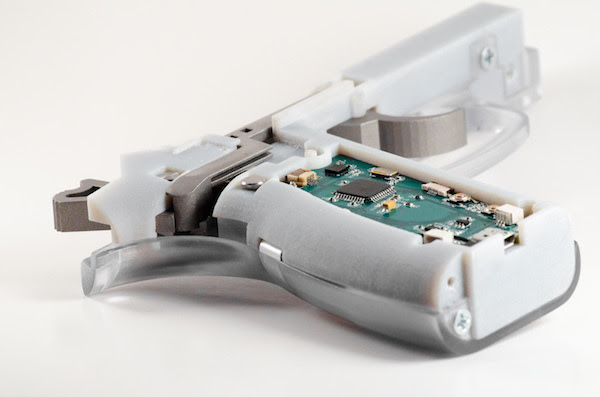
The gun works by recording the fingerprints of the user inside its self contained data base, which means no information is uploaded to any other server. This makes the weapon's computer very hard to hack, and does not jeopardize the owner's personal information.
Kloepfer came up with the idea two years ago when he needed something for his high school science project. “The idea came to me right as I was falling asleep. It was kinda in the back of my mind because of the shooting,” said Kloepfer, alluding to the Aurora, Colorado shooting that had been on everyone’s mind at the time. The shooting was just an hour’s drive from his home. “I scribbled it down before I went to bed and fell asleep and then in the morning I began my research,” He explained.
Kloepfer’s parents helped him in monetary increments to get the parts needed for each improvement. It would eventually cost $3000 for the whole thing to come together. “At first it was just a concept on paper,” he tells me. The gun went from phase to phase with each science fair. “Right now it’s a prototype on a plastic model. Its not entirely there but it works,” he says.
There is NO reason why this kind of technology should not be embraced the NRA and gun owners around the world.
And if they did so it could dramatically reduce the number of accidental shootings, increase the safety of our loved ones, and do a great deal to qualm the fears of those calling for stricter gun laws.
Colorado has a history with gun violence so it’s only appropriate that 17-year-old Kai Kloepfer, a high school student from Boulder, would want to apply biometric user authentication to firearms. Kloepfer just won the $50,000 Smart Tech for Firearms Challenge for his smart gun prototype.
Angel investor and gun reform advocate Ron Conway became the main backer of the $1 million Smart Tech prize to spur gun safety solutions earlier this year. “Let’s use innovation to bring about gun safety. Let’s not rely on Washington,” Conway told the SF Examiner in January. According to the Smart Tech Foundation, a total of 15 innovators will receive a part of that million dollar prize. Kloepfer is the first to get the award.
The gun works by recording the fingerprints of the user inside its self contained data base, which means no information is uploaded to any other server. This makes the weapon's computer very hard to hack, and does not jeopardize the owner's personal information.
Kloepfer came up with the idea two years ago when he needed something for his high school science project. “The idea came to me right as I was falling asleep. It was kinda in the back of my mind because of the shooting,” said Kloepfer, alluding to the Aurora, Colorado shooting that had been on everyone’s mind at the time. The shooting was just an hour’s drive from his home. “I scribbled it down before I went to bed and fell asleep and then in the morning I began my research,” He explained.
Kloepfer’s parents helped him in monetary increments to get the parts needed for each improvement. It would eventually cost $3000 for the whole thing to come together. “At first it was just a concept on paper,” he tells me. The gun went from phase to phase with each science fair. “Right now it’s a prototype on a plastic model. Its not entirely there but it works,” he says.
There is NO reason why this kind of technology should not be embraced the NRA and gun owners around the world.
And if they did so it could dramatically reduce the number of accidental shootings, increase the safety of our loved ones, and do a great deal to qualm the fears of those calling for stricter gun laws.
Labels:
accidental shootings,
Colorado,
data,
fingerprints,
gun deaths,
guns,
NRA,
science,
technology
Subscribe to:
Posts (Atom)