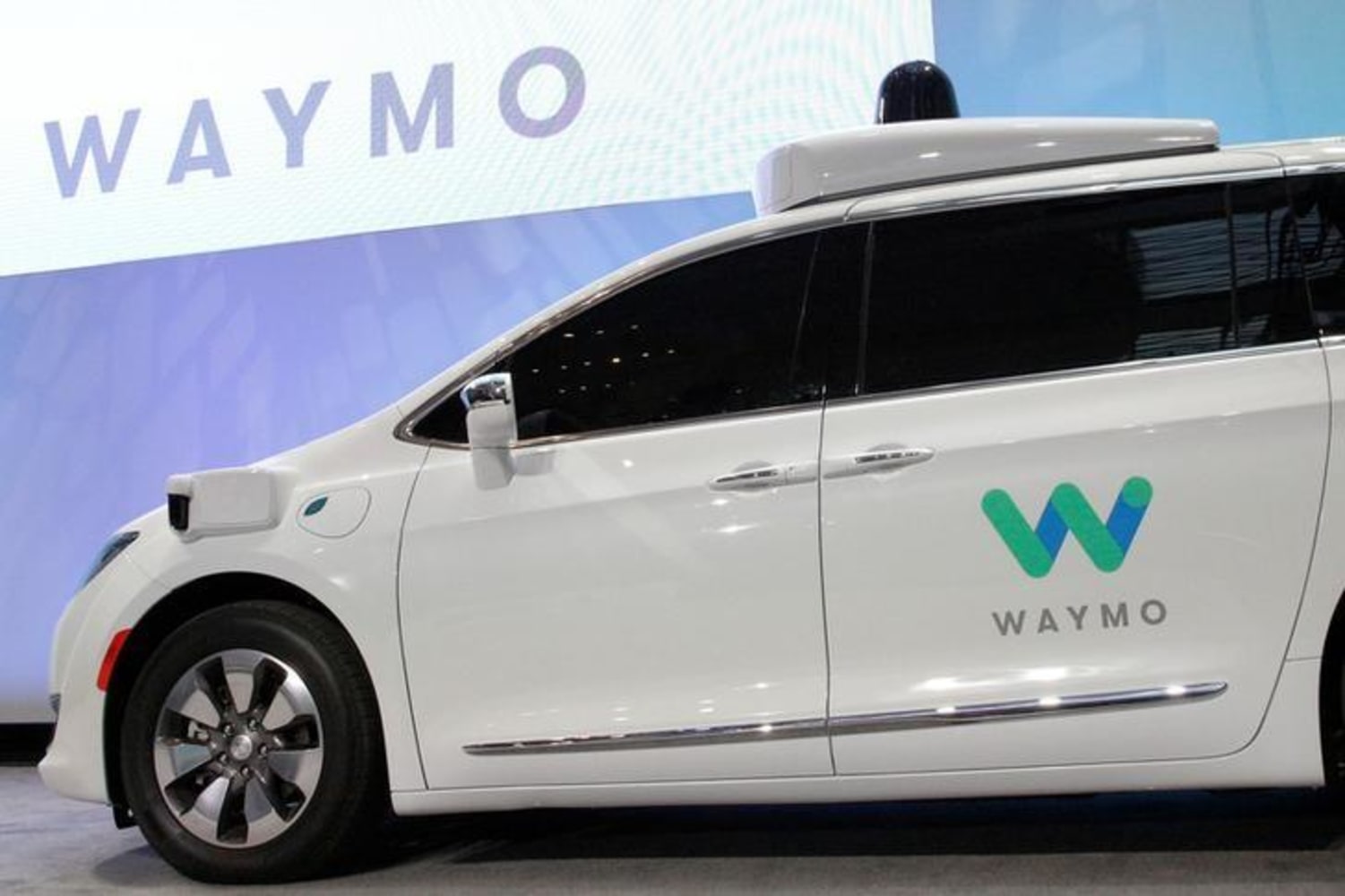
Courtesy of Ars Technica:
Real driverless cars could come to the Phoenix area this year, according to a Monday report from The Information's Amir Efrati. Two anonymous sources have told Efrati that Google's self-driving car unit, Waymo, is preparing to launch "a commercial ride-sharing service powered by self-driving vehicles with no human 'safety' drivers as soon as this fall."
Obviously, there's no guarantee that Waymo will hit this ambitious target. But it's a sign that Waymo believes its technology is very close to being ready for commercial use. And it suggests that Waymo is likely to introduce a fully driverless car network in 2018 if it doesn't do so in the remaining months of 2017.
......
According to Efrati, Waymo's service is likely to launch first in Chandler, a Phoenix suburb where Waymo has done extensive testing. Waymo chose the Phoenix area for its favorable weather, its wide, well-maintained streets, and the relative lack of pedestrians. Another important factor was the legal climate. Arizona has some of the nation's most permissive laws regarding self-driving vehicles.
"Arizona’s oversight group has met just twice in the last year, and found no reason to suggest any new rules or restrictions on autonomous vehicles, so long as they follow traffic laws," the Arizona Republic reported in June. "The group found no need to suggest legislation to help the deployment."
This of course is still in its infancy, and I imagine that even when these cars start showing up all around the lower 48 that here in my home state of Alaska we will be among the last to have access, due to our inclimate weather and treacherous driving conditions.
I just hope that it finally arrives while I am still around to participate in this amazing breakthrough.
This is without a doubt when of my all time favorite technological advances.
Morality is not determined by the church you attend nor the faith you embrace. It is determined by the quality of your character and the positive impact you have on those you meet along your journey
Showing posts with label autonomous cars. Show all posts
Thursday, October 05, 2017
Sunday, September 24, 2017
Gryphen posts a somewhat negative article about autonomous cars.
Courtesy of The Guardian:
Driverless vehicles could build a “gold mine” of personal data for private companies and would make it easier for them to target people as consumers, an Australian law professor has warned.
Des Butler, of the Queensland University of Technology, said the privacy risks involved in driverless vehicles were a “sleeper issue” that regulators were yet to fully consider, even though car manufacturers say the technology could be on roads in Australia by 2020.
“These vehicles will know where you like to frequent, which businesses, and may very well build a profile of you,” Butler said. “People will go into these things not realising just how much data the vehicle will be generating about them and not knowing the extent to which the data can be used.”
As even the most casual IM visitor has probably surmised I am essentially all in for driverless cars.
However in the interest of being fair I wanted to share a least a few articles which point out potential hazards or concerns.
Trust me it's not going to keep me from purchasing one at some point, but yes there could be issues with privacy, hackers, and occasional technological malfunctions.
In the meantime around 3,287 people are dying each day due to car accidents with an additional 20 to 50 million injured or disabled each year. (Source.)
Just to keep things in perspective.
Labels:
autonomous cars,
progress,
technology,
The Guardian
Thursday, September 07, 2017
House passes driverless car bill. Welcome to the future!
Courtesy of The Hill:
The House passed a bipartisan driverless car bill on Wednesday, advancing what could become the first set of federal laws for the emerging industry.
The “Self Drive Act” was unanimously approved by the House Energy and Commerce Committee in July, before Congress left for August recess, and passed the full House on a voice vote.
“Self-driving cars hold the promise of making America’s roads safer, creating new economic opportunities, and helping seniors and those with disabilities live more independently," Commerce Chairman Greg Walden (R-Ore.) and Rep. Bob Latta (R-Ohio) said in a joint statement. “This bipartisan bill paves the way for advanced collision avoidance systems and self-driving cars nationwide, and ensures that America stays a global leader in innovation.”
.....
Lawmakers and industry advocates say it is necessary to speed up the development of driverless technology in order to improve traffic safety. The bill comes amid an uptick in traffic deaths in the U.S.
"Self-driving cars have the potential in the future to reduce deaths and injuries from car crashes, particularly those that result from driver distraction," Rep. Frank Pallone Jr. (D-N.J.), the top Commerce Committee Democrat, said on the House floor ahead of the vote. "This bill allows for testing and deployment of self-driving cars to help the United States reach that potential sooner."
According to one estimate, self-driving cars could reduce traffic fatalities by up to 90 percent.
I know that a whole lot of people are still uncertain about all of this, but I for one can hardly wait.
I was never a big fan of driving in the first place, so it is not something I plan to miss.
Besides I am getting older, and having a car that can take me where I want to go without having to worry about if I can see at night, or whether or not my reflexes are still fast enough to avoid collisions, or if I can even remain conscious for a drive lasting longer than two hours, sounds pretty damn good to me.
Labels:
autonomous cars,
Congress,
driverless cars,
the future,
The Hill
Sunday, July 16, 2017
Elon Musk predicts that in 20 years new cars will no longer include a steering wheel.
Courtesy of Axios:
Elon Musk predicted that within 10 years nearly all new cars made in the U.S. will be autonomous, and half of those will be fully electric vehicles. "China is probably going to be ahead of that," the Tesla and SpaceX chief said Saturday, speaking at the National Governors Association meeting in Providence, Rhode Island.
Within 20 years, he said driving a car will be like having a horse (i.e. rare and totally optional). "There will not be a steering wheel."
This piggybacks well with my post from yesterday morning that predicted that all new cars in Europe will be electric by the year 2035.
I know a lot of you poo poo'd that prediction so I imagine this one will also receive some blowback from the those who fear and mistrust change as well.
But whether you like it or not the future is one where cars run on batteries and people are merely the passengers.
Remember, there was a time not so very long ago when research required a trip to the library, phones were attached to the wall, and computers took up several rooms of space.
We cannot imagine having to live without the conveniences we now take for granted, and soon the same will be true for manual driving.
Musk also had this to say about the future of energy:
Musk noted that it would only take about 100 square miles of solar panels to power the entire United States and the batteries needed to store the energy would only need to take about a square mile. That said, he imagines the energy shifting to a large dose of rooftop solar, some power plant solar, along with wind, hydro and nuclear power.
"It's inevitable," Musk said, speaking of shifting to sustainable energy. "But it matters if it happens sooner or later."
Personally I am very excited about the future. Well at least the future of technology.
I am still not at all confident that human beings are evolving as quickly as out technical advances.
Labels:
autonomous cars,
Axios,
electric cars,
Elon Musk,
progress,
technology,
the future
Sunday, June 11, 2017
Governor of Washington signs order to let the autonomous automobiles drive without human chaperones.
Courtesy of The Drive:
Washington governor Jay Inslee signed an order Wednesday that could allow self-driving car tests to begin in the state in just under two months and without a human monitoring from the driver's seat, his office announced in a blog post the same day.
The order gives self-driving car companies the ability to send applications to the state's Department of Licensing for self-driving car pilot program tests on public roads. In the governor's blog post and in the official order, it states that around 94 percent of all motor vehicle crashes are caused by driver error, and officials believe the use of autonomous cars could have a powerful impact on that.
Additionally, the governor's order brings a handful of state agencies together that will work with the approved self-driving companies and craft future legislation based on the upcoming trials.
Inslee showed that has pretty much absolute trust in the tech when compared to the capabilities of human drivers, according to a statement obtained by The Seattle Times.
“One thing I know about radar, it doesn’t drive drunk, it doesn’t drive distracted,” Inslee said, according to The Seattle Times. “We humans are really good at a lot of things, driving cars isn’t necessarily one of them compared to the automated processes that are digital and foolproof. I just have huge confidence in the safety aspects of this.”
Autonomous automobiles is one of my favorite things to cover outside politics and religion, probably because it is both terrifying and awesome at the same time.
It is also inevitable.
Just like fear of drowning did not keep us land bound, and fear of flying did not stop the airline industry, our fear of giving up control to machines will not stop the coming of autonomous automobiles.
We already rely on machines to remember our phone numbers, fly our planes, and answer all of our questions, so how is this really any different?
I for one can hardly wait to let Google take the wheel and allow me to sit back and enjoy the ride.
Labels:
autonomous cars,
progress,
the future,
transportation,
Washington
Thursday, January 05, 2017
Autonomous commercial big rigs means the loss of jobs for 1.7 million truck drivers.
Courtesy of DC Velocity:
The proliferation of self-driving, or autonomous, tractor-trailers threaten the jobs of nearly 1.7 million commercial truck drivers, according to a study published late last month by the White House Council of Economic Advisers (CEA).
The study, released Dec. 20, said the jobs of between 1.34 million and 1.67 million truck drivers would be at risk due to the growing utilization of heavy-duty vehicles operated via artificial intelligence. That would equal 80 to 100 percent of all driver jobs listed in the CEA report, which is based on May 2015 data from the Bureau of Labor Statistics, a unit of the Department of Labor. There are about 3.4 million commercial truck drivers currently operating in the U.S., according to various estimates.
The report also predicted that between 165,300 and 495,900 jobs held by light truck or delivery service drivers would be at risk because of autonomous vehicles. That represents between 20 and 60 percent of the CEA's universe of 825,000 driver jobs. Fewer of those drivers are likely to be displaced, because they operate in more densely populated urban areas where the risk of pedestrian deaths or injuries would be greater if autonomous vehicles were used. In addition, many delivery drivers operate over short distances, so labor costs would be less of a factor.
CEA estimated that, on a net basis, the use of autonomous vehicles enabled by artificial intelligence would threaten between 2.2 million and 3.1 million full- and part-time driver jobs of all types; the figure includes approximately 364,000 self-employed individuals driving with ride-sharing services like Uber and Lyft.
Once again, whether we like it or not, this IS our future.
This article really caught my attention because I had a guy about 23 years old asking if I thought becoming a trucker was a good career move, and I told him bluntly that I don't think the job will exist in the next twenty years.
This article essentially supports that conclusion.
And this is just one example of how automation is going to reduce the need for human workers in the very near future.
Donald Trump can talk about bringing jobs back until he is orange in the face (Oops, too late!) but the simple fact is that with these new advancements in computer technology and automation, there are going to be fewer and fewer jobs available for carbon based life forms.
There is already talk about creating a minimum income, or mincome, for non-working people so that they can live in relative comfort while machines do the heavy lifting.
Personally I am somewhat confident that my job will not be taken over by automation until well after I am too old to adequately perform my duties anyhow.
As for the rest of humanity, well I would suggest that learning to program computers and repair circuit boards might be a good place to start. Though I think we know it is only a matter of time before machines will evolve to take those tasks over as well.
Labels:
autonomous cars,
change,
progress,
the future,
trucks,
unemployment,
work
Saturday, December 31, 2016
I appears that driverless cars may not be good news for everybody. Especially those on the organ donor list.
Courtesy of Slate:
Much has been said about the ways we expect our oncoming fleet of driverless cars to change the way we live—remaking us all into passengers, rewiring our economy, retooling our views of ownership, and reshaping our cities and roads.
They will also change the way we die. As technology takes the wheel, road deaths due to driver error will begin to diminish. It’s a transformative advancement, but one that comes with consequences in an unexpected place: organ donation.
It’s morbid, but the truth is that due to limitations on who can contribute transplants, among the most reliable sources for healthy organs and tissues are the more than 35,000 people killed each year on American roads (a number that, after years of falling mortality rates, has recently been trending upward). Currently, 1 in 5 organ donations comes from the victim of a vehicular accident. That’s why departments of motor vehicles ask drivers whether they want to be donors.
It’s not difficult to do the math on how driverless cars could change the equation. An estimated 94 percent of motor-vehicle accidents involve some kind of a driver error. As the number of vehicles with human operators falls, so too will the preventable fatalities. In June, Christopher A. Hart, the chairman of the National Transportation Safety Board, said, “Driverless cars could save many if not most of the 32,000 lives that are lost every year on our streets and highways.” Even if self-driving cars only realize a fraction of their projected safety benefits, a decline in the number of available organs could begin as soon as the first wave of autonomous and semiautonomous vehicles hits the road—threatening to compound our nation’s already serious shortages.
Damn, talk about unforeseen circumstances. I certainly did not see this one coming.
However what advances in science taketh away, it cannot also giveth back.
In this case the solution to this problem may be organs grown in a laboratory for the express purpose of providing transplants to patients in need.
Of course that technology is still in its beginning stages, but desperate need has a tendency to expedite the scientific process.
It's either that or we build flaws into the autonomous car manufacturing so that every so often a car simply veers off into oncoming traffic and voila, new organs are instantly made available.
I'm not necessarily an ethicist but that does seem slightly wrong to me.
Labels:
autonomous cars,
medicine,
organs,
progress,
science,
technology
Monday, December 12, 2016
Michigan signs bill to allow driverless cars on their public roadways.
Courtesy of Computerland:
The governor of Michigan today signed into law a series of bills that allows fully autonomous vehicles, including those without drivers and steering wheels, to begin using public roadways.
Flanked by a Ford Model T and a self-driving Ford Fusion, Gov. Rick Snyder signed four bills as part of the autonomous vehicles legislative package that allows the operation of autonomous vehicles on Michigan public roads. Before, only testing of the vehicles by manufacturers was permitted.
"As far as I know, Michigan is the first state to make it official that these types of vehicles can be used on public roads," said Brandon Schoettle, a project manager with the University of Michigan's Transportation Research Institute.
"California is also planning to enact similar legislation soon. Obviously, the general act of vehicles driving around like this on any public roads is somewhat unprecedented anywhere, given the very recent introduction of such technology," Schoettle said.
Here it comes folks, that future thing that everybody is always talking about.
My daughter and I have been arguing about autonomous cars for a while now.
She is against them, likes to drive herself, and I am all for them.
I'm getting older and I like the idea that technology will allow me to be independent and able to get around on my own even after my reflexes are shot and my eyesight dims.
Hell I already have a machine that cleans my clothes, a robot that vacuums my house, and several technological devices that allow me to converse with people from all over the world from the comfort of my office in Alaska.
So why wouldn't I be willing to trust a machine to get me around town on its own?
Labels:
autonomous cars,
driverless cars,
Michigan,
technology,
the future
Subscribe to:
Posts (Atom)


