Even as an increasing number of Americans declare their disbelief in God, the nation as a whole continues to hold a dim view of atheists, in large part due to non-believers' perceived lack of morality. However dubious its premise, the assertion "There is no good without God" reflects a widely held mindset.
But it turns out that's not the whole story. Newly published research finds another dynamic driving antagonism toward atheists: They threaten the comforting narratives that gives meaning to so many people's lives, and make the thought of death bearable.
Humans instinctively search for ways of "mitigating the potential terror arising from the uniquely human awareness of death," writes a research team led by psychologist Corey Cook of the University of Washington-Tacoma. Atheists "pose a fundamental threat" to the belief systems that perform this vital function.
Writing in the journal Social Psychological and Personality Science, the researchers report "hostility toward, and mistrust of, atheists is particularly pronounced when existential concerns are involved." Even more tellingly, they also find that "among believers, the mere contemplation of atheism can arouse intimations of mortality."
In other words the very idea that there are those who are living their lives fully aware of their own mortality, and requiring no comforting stories of an afterlife in order to function, anger and frighten those who require those comforts in order to get through each day.
I have actually seen this myself.
I have, at various times in my life, introduced myself to religious people as either an agnostic, an Atheist, or a Taoist.
If I say I am a Taoist they are usually put at ease and express interest in learning more about my "faith."
If I claim the label of "agnostic" they become parental and imagine that I have merely lost my way and suggest that if I read the "good book," or attend services, I will return to faith.
However if I mention that I am an Atheist, even in a non-threatening offhand manner, they immediately demonstrate suspicion and will often finish the conversation quickly and walk away, or aggressively challenge my "ignorance."
To be honest that last one has not happened in more than a decade. I am an excellent debater and can leave my opponents bloodied and mentally exhausted.
That of course is why I feel it so important to always identify myself as an Atheist.
Not only is it completely disconcerting to the faithful, but to do anything else would demonstrate a lack of courage on my part.
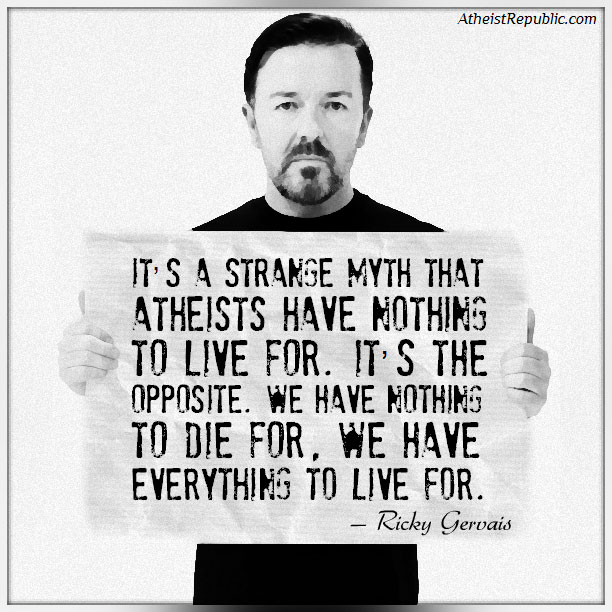
In my opinion the Atheist is the most courageous human on the planet. A man or woman who walks through life fully aware that the sands of time are running out on their existence, yet rising each morning to greet day, not with despair for how little time remains, but with hope in their hearts for all they might accomplish before the end, is someone to be admired.
How can one argue that the Atheist soldier is not far more courageous than his Christian counterpart who believes that God watches over him, and that his death will merely usher in the beginning of a better existence?
Or that the non-believing firefighter who runs into the burning building, and knows if he is trapped will never see his loved ones again, is far braver than the man who believes his family will some day join him in heaven?
For every heroic person who has impressed us through the years, imagine how much more heroic they must have been to take such risks knowing that they were risking, and possibly losing, the only life they will ever know.
That is why I proudly stand up and claim the mantle of Atheist.
And if by doing so it makes the faithful fear for their mortality, that is no fault of mine, but rather a flaw in their own character.