 |
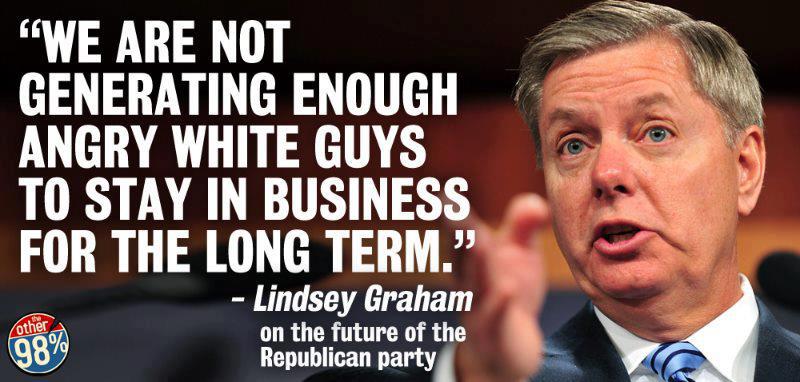
| Lindsey knows what's up. |
It turns out that one of the Grand Old Party’s biggest—and least discussed—challenges going into 2016 is lying in plain sight, written right into the party’s own nickname. The Republican Party voter is old—and getting older, and as the adage goes, there are two certainties in life: Death and taxes. Right now, both are enemies of the GOP and they might want to worry more about the former than the latter.
There’s been much written about how millennials are becoming a reliable voting bloc for Democrats, but there’s been much less attention paid to one of the biggest get-out-the-vote challenges for the Republican Party heading into the next presidential election: Hundreds of thousands of their traditional core supporters won’t be able to turn out to vote at all.
The party’s core is dying off by the day.
Since it appears that no political data geek keeps track of voters who die between elections, I took it upon myself to do some basic math. And that quick back-of-the-napkin math shows that the trend could have a real effect in certain states, and make a battleground states like Florida and Ohio even harder for the Republican Party to capture.
By combining presidential election exit polls with mortality rates per age group from the U.S. Census Bureau, I calculated that, of the 61 million who voted for Mitt Romney in 2012, about 2.75 million will be dead by the 2016 election. President Barack Obama’s voters, of course, will have died too—about 2.3 million of the 66 million who voted for the president won’t make it to 2016 either. That leaves a big gap in between, a difference of roughly 453,000 in favor of the Democrats.
Here is the methodology, using one age group as an example: According to exit polls, 5,488,091 voters aged 60 to 64 years old supported Romney in 2012. The mortality rate for that age group is 1,047.3 deaths per 100,000, which means that 57,475 of those voters died by the end of 2013. Multiply that number by four, and you get 229,900 Romney voters aged 60-to-64 who will be deceased by Election Day 2016. Doing the same calculation across the range of demographic slices pulled from exit polls and census numbers allows one to calculate the total voter deaths. It’s a rough calculation, to be sure, and there are perhaps ways to move the numbers a few thousand this way or that, but by and large, this methodology at least establishes the rough scale of the problem for the Republicans—a problem measured in the mid-hundreds of thousands of lost voters by November 2016.
I realize that it's a little macabre. But then again it is also quite uplifting news for those of us who, unlike Marco Rubio, do not want the same tired old ideas and prejudices of the "good old days" reinforced by legislation pushed through the Congress by old men constantly reelected by even older men.
The future is bright, and not so sadly many of the Republican base will not live long enough to see it.
Nor get the chance to yell at it and tell it to get the hell off their lawn.

