Showing posts with label secular. Show all posts

Monday, December 07, 2015

Just in time for the holidays.

 Courtesy of the Freedom From Religion Foundation:

The Freedom From Religion Foundation's Winter Solstice sign has just returned to the Illinois State Capitol for its seventh display. 

"This sign is a reminder of the real reason for the season, the Winter Solstice," says Annie Laurie Gaylor, FFRF co-president, which is the shortest and darkest day of the year, and takes place on Dec. 22 this year. The natural holiday heralds the rebirth of the sun and the natural new year, and has been celebrated for millennia in the Northern Hemisphere with festivals of light, evergreens, feasts and gift exchanges. 

"We nonbelievers don't mind sharing the season with Christians," Gaylor adds, "we just don't like the pretense that it's about a supernatural birth of a god." 

An engraved sign with the same wording has been erected by the Foundation for 20 Decembers in a row at the Wisconsin State Capitol in Madison, Wis. 

Should fit quite nicely next to the Christian Nativity, the Jewish Menorah, and the Kwanzaa Bendera ya Taifa. 

(Hat tip to The Friendly Atheist.)

Saturday, November 07, 2015

More good news about the end of religion in America.

Courtesy of Quartz:  

Pew’s new report—which surveyed 35,071 people in 2014, and encompasses the second half of findings released in May—can be juxtaposed with the group’s similarly sized 2007 study on the same topic. Americans who are “absolutely certain” in God’s existence have decreased by eight percentage points in the intervening time. Religiously unaffiliated people now make up 23% of the adult population, compared to 16%; even among the pious, regular service attendance is faltering. 

When sorted by generation, the contrasts get even starker. Younger Americans, by some measures, are almost twice as likely to be uninterested in religion as their parents and grandparents. For instance: only 27% of millennials attend weekly religious services, versus 51% of adults in the Silent Generation (those aged 70 to 87). Emphasis on the importance of religion is also lagging. 

The wide difference in generational religious interest is explained in part by people’s tendency to care more about religion as they age—a caveat Pew has carefully noted. But even so, the research group finds that younger people nowadays aren’t showing the same increase in religious fervor when they get older as past generations did. 

“As older cohorts of adults … pass away, they are being replaced by a new cohort of young adults who display far lower levels of attachment to organized religion than their parents’ and grandparents’ generations did when they were the same age,” wrote the authors of the report.

As I have mentioned before, I have been here all along, unshackled by fear, prejudice, and superstition, just waiting for everybody else to finally join me. 

And increasingly they have been doing exactly that.

Monday, September 14, 2015

Around half of those raised in Catholic churches have abandoned their faith, and around half of those have abandoned religion altogether.

Courtesy of HuffPo:  

Roughly half of Americans raised in Catholic households have left the church at some point -- and most of them have stayed away for good, according to a recent report by Pew Research Center. 

These "former Catholics" make up 15 percent of the U.S. population, according to another recent survey by Public Religion Research Institute. These Americans are largely abandoning religion altogether after leaving the Catholic Church, while others find new homes in Protestant denominations and non-Christians faiths.

And the good news just keeps right on coming. 

Saturday, January 17, 2015

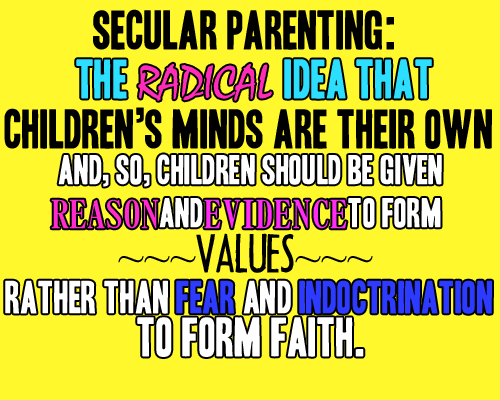
Apparently people are still surprised that secular parents are raising children with good morals and values.

Courtesy of LA Times:  

So how does the raising of upstanding, moral children work without prayers at mealtimes and morality lessons at Sunday school? Quite well, it seems. 

Far from being dysfunctional, nihilistic and rudderless without the security and rectitude of religion, secular households provide a sound and solid foundation for children, according to Vern Bengston, a USC professor of gerontology and sociology. 

For nearly 40 years, Bengston has overseen the Longitudinal Study of Generations, which has become the largest study of religion and family life conducted across several generational cohorts in the United States. When Bengston noticed the growth of nonreligious Americans becoming increasingly pronounced, he decided in 2013 to add secular families to his study in an attempt to understand how family life and intergenerational influences play out among the religionless. 

He was surprised by what he found: High levels of family solidarity and emotional closeness between parents and nonreligious youth, and strong ethical standards and moral values that had been clearly articulated as they were imparted to the next generation. 

“Many nonreligious parents were more coherent and passionate about their ethical principles than some of the ‘religious' parents in our study,” Bengston told me. “The vast majority appeared to live goal-filled lives characterized by moral direction and sense of life having a purpose.” 

My own ongoing research among secular Americans — as well as that of a handful of other social scientists who have only recently turned their gaze on secular culture — confirms that nonreligious family life is replete with its own sustaining moral values and enriching ethical precepts. Chief among those: rational problem solving, personal autonomy, independence of thought, avoidance of corporal punishment, a spirit of “questioning everything” and, far above all, empathy. 

For secular people, morality is predicated on one simple principle: empathetic reciprocity, widely known as the Golden Rule. Treating other people as you would like to be treated. It is an ancient, universal ethical imperative. And it requires no supernatural beliefs. As one atheist mom who wanted to be identified only as Debbie told me: “The way we teach them what is right and what is wrong is by trying to instill a sense of empathy ... how other people feel. You know, just trying to give them that sense of what it's like to be on the other end of their actions. And I don't see any need for God in that. ...

That last part is dead on.

You know I don't talk about it much but I was married for fourteen years to the daughter of a minister.

She had a lot of weird hangups concerning nudity, alcohol consumption, and using curse words, but virtually no problem with lying, taking things that did not belong to her, or saying terrible things behind people's backs.

In the marriage it was also up to me to deal with setting guidelines for the children, and it was not uncommon to have little to no backup from my Christian wife.

However I must have done something right, because my daughter is an even bigger stickler for the rules than I am, and often functions as my moral sounding board when I stumble into a gray area.

And NO she did not get that way by way of HER Fundamentalist mother either.  Trust me on that.

Saturday, March 15, 2014

One in five Americans say that religion is not that important to them.

Courtesy of HuffPo:  

Americans are losing faith. At least, that's the conclusion of a new poll on religion. 

Jointly conducted by NBC and The Wall Street Journal, the poll found that 21 percent of Americans feel religion is "not that important" in their lives. 

This, NBC News writes, is the "highest percentage" recorded since the survey was first conducted in 1997. "The poll showed that these less religious Americans are more likely to be men, have an income over $75,000, to live in the Northeast or West and to be under the age of 35," says NBC.

Progress can sometimes move inexorably slow, but move it does.

Every year we are seeing faith receding and critical thinking expanding.

It is almost enough to make this godless heathen shed a tear.

Monday, November 25, 2013

Friday, July 19, 2013

National Atheist Party changes its name seeking greater acceptance. Good luck with that. Update!

Courtesy of HuffPo:

In a vote last week, members of the political group -- which supports secular government and the reinforcement of the separation of church and state -- selected the "Secular Party of America" as their new name. The change had reportedly been in the works for months, and over 75 percent of the party's members voted in support of the rebrand. 

Vice President of Public Relations and Marketing Bernard “Flash” Kellish“ hailed the move in a statement. 

"We are certain that not only is the new name far more inclusive of a greater number of Americans that share our vision of true separation of church and state, but that it will open the door to those that may not have joined us if for no other reason than because 'Atheist' was in the name," he said. "We were created by atheists as a way to be a hereunto unrepresented voice in politics and have been very successful. We will miss the old name but now it is time to move forward and focus on being a viable and respected political party. We hope to make a worldwide network of secular organizations.”

First off I should point out that I do not belong to the NAP so I have no right to tell them how to move their agenda forward. As you know I'm not much of a joiner.

However I would like to point out that this smacks of the same kind of insecurity which inspired the Liberals to re-brand themselves as "progressives."  Personally I always thought that was a capitulation to the conservative forces which kept trying to vilify liberals.

My attitude was "Fuck them, they're not the boss of me!" And remains so to this day.

I have to say I feel much the same about this. I personally take great pains to point out that I am an Atheist and then, hopefully, give people the opportunity to see that I am not the evil, dangerous, immoral person that many religious people would have you believe that I am.

In fact I believe Atheists to be the moral superior of ANYBODY who claims to be a God fearing individual who lives a moral life due to their superstitious belief that by not doing so they risk being denied heaven and instead will be forced to suffer in agony for eternity.

In my personal view of Atheists I see us as intelligent individuals who have carefully investigated the claims made by the world's religion and found that none of them provided compelling evidence to support their claims, And who furthermore have made the choice to courageously advertise to a world filled with religious and superstitious people that we do not share your need to cling to unprovable dogmatic assertions about reality out of fear of being alone or death.

Caving to pressure from others is to deny who I am would be a betrayal of self, and an act of abject cowardice.

But hey, I wish the "Secular Party of America" great success.

Update: For those questioning my assertion that Atheists are the least trusted and most reviled group on the planet I suggest you educate yourselves by reading here, here, and here.

Sunday, May 13, 2012

Just in time for Mother's Day, study shows that the BEST place to be a mother is in secular countries. Yeah, I said it!

Courtesy of God Discussion:

Comparing Save the Children's data with other statistics, with the exception of New Zealand and Australia, secular countries having high populations of atheists/agnostics are the best places to be a mother. Countries having the most restrictions on abortion fell into the worst countries to be a mother and conversely, those where abortion is legal were the best environments to be a mother. 

The United States ranks 25 out of 43 developed nations, up from 31 last year. 

While the US has moved up in the rankings, ahead of last year’s 31st place, we still fall below most wealthy nations,” said Carolyn Miles, President & CEO of Save the Children. “A woman in the US is more than 7 times as likely to die of a pregnancy-related cause in her lifetime than a woman in Italy or Ireland. When it comes to the number of children enrolled in preschools or the political status of women, the United States also places in the bottom 10 countries of the developed world.” 

The study analyzed factors like education, economics, health and politics for mothers and their children.

It makes sense actually, a parent who raises a child with access to logic and information to use as their guide, is ALWAYS going to do a better job than somebody who is encouraged to utilize the "spare the rod, spoil the child" approach or to tell their little one that if they misbehave they will burn for all eternity in the fiery pits of hell. Don'tcha think?

Happy Mother's Day! (Of course it will probably be even happier if you live in a secular country. I'm just saying!)

Friday, December 23, 2011

I am not sure how much this helps President Obama, but it certainly made me feel better about supporting him.

"Don't worry Atheists, I have your back."
Courtesy of the Secular Coalition:

The Secular Coalition for America today released its 2012 Presidential Candidate Scorecard—a guide for secular-minded Americans on the presidential candidates in the upcoming 2012 election. The scorecard ranks the major candidates of both Republican and Democratic parties on issues important to nontheistic Americans, and all Americans who support a robust separation of church and state. 

Of the three leading Republican candidates, former Massachusetts Governor Mitt Romney and U.S. Representative Ron Paul received mostly negative scores, while former U.S. Representative and Speaker of the House Newt Gingrich received a grade of “F” in almost every category. U.S. Representative Michelle Bachmann, Texas Governor Rick Perry, and former U.S. Senator Rick Santorum also received almost exclusively negative grades in most categories. Former Utah Governor and Ambassador to China Jon Huntsman and President Barack Obama received mixed positives. 

“Given the current political climate, I’m not surprised that the candidates received mixed ratings at best,” said Herb Silverman, President of the Secular Coalition for America. “Nontheists almost never get the opportunity to vote for a candidate who openly acknowledges being an atheist, but it’s frightening to see that at least half of the candidates don’t have a basic understanding of the principle of separation of church and state on which our country was founded.” 

The scorecard assigned grades of "A", "B", "C" or "F" to the eight major candidates based on their public statements and actions on nine subjects: 

  • Attitude Toward Nontheists 
  • Church & State Separation 
  • Taxpayer Funding of Religion 
  • God, Faith & Governance Endorsements & Associations 
  • Evolution 
  • Scientifically Based Regulations & Legislation 
  • Religious Discrimination & Civil Rights 
  • Religious Refusal Laws

Here is the scorecard.


For anybody who does NOT believe that Christianity is the only true path to God, or who respects the separation of church and state, this is a VERY troubling indication of what kind of candidates are running for the highest political office in the country.

Saturday, November 26, 2011

Not trying to convert anybody, just throwing this out there. Top Ten Reasons to be an Atheist Nation.

Yeah it does! Oh wait, were you being sarcastic?
Courtesy of Atheist Connect:

#10 – Lower Crime Rates 
 That’s right, secular countries have the lowest crime rates and are the safest places on the planet.

#9 – Lower Homicide Rate 

#8 – Lower Rates of Sexually Transmitted Diseases 
Almost all secular nations have sex education programs for children, confidential public health-care programs to treat sexually transmitted diseases for free, publicly advertised programs to educate the masses about sexually transmitted diseases, and free condoms for any and all. 

#7 – Lower Rates of Infant Mortality 
Why do religious countries have higher rates of infant mortality? It is probably because of the demonization of unwed mothers by religious societies. Combine this demonization with an inability to receive an abortion, and you will have a large group of mothers having children that they don’t want and/or can’t economically afford. 

#6 – Lower Rates of Teen Pregnancy 
As should be clear by now, secular nations tend to encourage sex education and have a far more honest understanding of human sexuality than religious nations. 

#5 – Lower Abortion Rates 
This is one of the hardest and most bitter pills that religious nations have to swallow, their policies of restricting the ability of women to receive an abortion, actually results in increased rates of abortion. 

#4 – Healthier Citizens 
The citizens of secular countries are healthier than the citizens of religious countries. The reasons for this difference are almost certainly due to a combination of factors involving public education, health-care policies, access to care, etc. 

#3 – Citizens have Better Personal Relationships 
The citizens of secular nations have better interpersonal relationships (and are more happy!) than the citizens of religious nations. Religious nations tend to demonize life-styles that don’t conform to their expectations, and tend to place women at a lower social status than men. 

#2 – Citizens Have Higher Education Rates 
 Secular nations such as Norway, Finland, etc., not only have citizens with an average education that is higher than religious countries, but the children of secular nations outperform religious children in math, science, and reading. 

#1 – Higher Per Capita Income 
Possibly the single most important reason why you should want to live in a secular nation instead of a religious nation, is that the citizens of secular nations make more money than the citizens of religious nations!

I am actually not at all positive that I agree with every one of these, but I will admit that some of them do seem quite obvious. However  I am certain I would not have chosen the making of more money as the number one reason to live in a Atheistic society.

Personally I LOVE conversations about religion since it is one of those taboo topics I was discouraged from discussing when I was a kid. Since I am now an adult, and have this handy blog at my disposal, it seems like the perfect place to open up a dialogue.

So what do you think? Do these statements, or perhaps a portion of these statements, seem reasonable to you?  And do you think religion overall makes for a better society, or does it interfere with the ability of humans to rise to their true potential?

P.S. If you want to read a longer explanation given for these assertions then click the link at the top.

P.P.S. By the way, in NO way do I agree with the definition of Atheism posted at the top, but I just think it is important that ALL of us be able to keep a good sense of humor so that feelings do not get hurt and we do not become so defensive that we cannot hear the honestly expressed opinions of others.